Travel to the End of the World
Undiscovered Places >> Europe>> Travel to the End of the World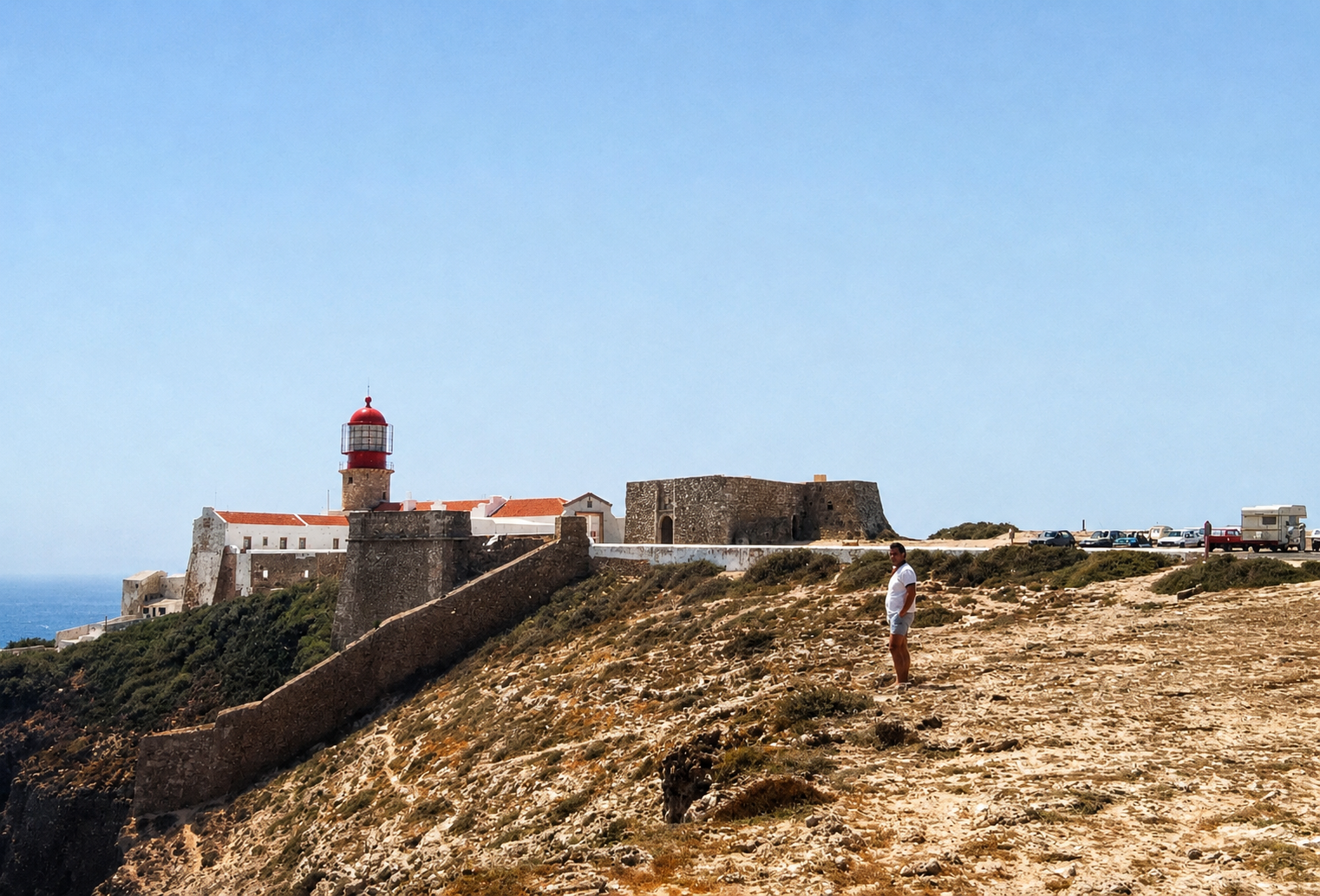
Travel to the End of the World
There are places that make you pause, not because they are crowded with attractions, but because they remind you just how vast the world really is. Cabo de São Vicente, on Portugal’s Algarve coast, is one of those places. For many, the Algarve is beautiful beaches; sun, sea and probably Sangria. But just along the coast from the Algarve hotspots is a unique site in Europe.
Standing at the south-western tip of mainland Europe, this dramatic headland feels like the end of the world. For centuries, sailors believed that beyond these towering cliffs lay only the unknown Atlantic Ocean. Even today, with aircraft overhead and GPS in our pockets, it is impossible not to feel a sense of awe as you gaze west across thousands of kilometres of open sea.

The End of the Road
The approach to the cape is almost deceptive. The landscape is dry and windswept, dotted with hardy shrubs that cling to the limestone. Then, almost without warning, the land simply ends. Sheer cliffs, rising nearly 75 metres above the ocean, plunge into deep blue water where Atlantic swells explode against the rocks in fountains of white spray.
Dominating the headland is the unmistakable red-topped lighthouse. Built in 1846 on the site of an earlier Franciscan monastery, its powerful light can be seen more than 50 kilometres out to sea. It continues a tradition of guiding mariners that stretches back many centuries, for this has always been one of Europe’s most important navigational landmarks.

Meeting History
History is woven into every stone here. The cape is named after Saint Vincent, a third-century Christian martyr whose remains were said to have been brought here after his death. During Portugal’s great Age of Discovery, Prince Henry the Navigator established his famous school of navigation nearby at Sagres, and generations of explorers sailed past these cliffs on voyages that would change the course of world history.
Yet Cabo de São Vicente is far more than a historical monument. It is a place to simply stand and watch. The Atlantic wind whistles across the plateau, seabirds soar effortlessly on rising air currents, and the ever-changing light transforms the colours of the cliffs from pale gold to rich ochre. On a clear day, the horizon seems almost infinite.
Sunset is the highlight for many visitors. As the sun sinks into the Atlantic, the sky becomes a spectacular canvas of oranges, pinks and deep reds. Hundreds gather quietly along the cliff edge, cameras soon forgotten as the final sliver of sunlight disappears beneath the horizon. There is spontaneous applause on some evenings—a fitting tribute to one of Europe’s finest natural performances.
Around the Area
The surrounding coastline is equally spectacular. Walking trails lead along the cliff tops, revealing hidden coves, sea stacks and breathtaking viewpoints. The nearby fortress town of Sagres, only a few kilometres away, makes an ideal base for exploring this remarkable corner of Portugal. Between the historic fort, pristine beaches and excellent seafood restaurants, it is easy to spend several days discovering the region.

One unexpected delight is the wildlife. The cape lies on a major migration route for birds travelling between Europe and Africa, making it one of Portugal’s finest locations for birdwatching. Peregrine falcons, kestrels and storks are regular visitors, while dolphins can occasionally be spotted offshore.
For photographers, Cabo de São Vicente offers endless opportunities. The stark contrast between the whitewashed lighthouse buildings, dark stone fortifications, golden cliffs and sapphire Atlantic creates images that seem almost too dramatic to be real. Every hour of the day brings different light and a different mood.
The Power of an End
There is something deeply satisfying about visiting Europe’s south-western extremity. Perhaps it is knowing that there is no more land between you and North America. Perhaps it is the relentless Atlantic wind, or the centuries of maritime history that seem to linger in the air. Whatever the reason, Cabo de São Vicente leaves a lasting impression.
It is not simply a place to tick off on an itinerary. It is somewhere to linger, breathe deeply, and appreciate the extraordinary power of nature. If your travels take you to Portugal’s Algarve, make time for this remarkable headland. Stand at the edge of Europe, listen to the ocean below, and understand why generations of sailors regarded this place with equal measures of respect, wonder and hope.
Getting there
If you are already visiting the Algarve, Cabo de São Vicente is easy to find – just drive along the main N268 to Sagres and then at the main roundabout in the town turn right to continue along the N268 along the coast until you run out of road.
If you’re staying in the central Algarve—around Albufeira, Vilamoura, Quarteira, or Faro—it is quite possible to reach Cabo de São Vicente by public transport, although it does take some planning. You start by taking the train to Lagos – that’s about an hour from Albufeira – and then from Lagos, catch the local VAMUS Algarve bus to Cabo de São Vicente.
Even if you’re staying in one of the Algarve’s beach resorts, don’t assume Cabo de São Vicente is too far away. With a train or bus to Lagos and a connecting local bus to Sagres and the cape, Europe’s south-western tip is within easy reach for a memorable day trip—and one of Portugal’s most spectacular sunsets.
Related Post
In Dylan Thomas’ Footsteps
Anyone growing up in Britain in the 60s or 70s will remember the sonorous tones…