The World of Green Gables
Undiscovered Places >> Canada>>North America>> The World of Green Gables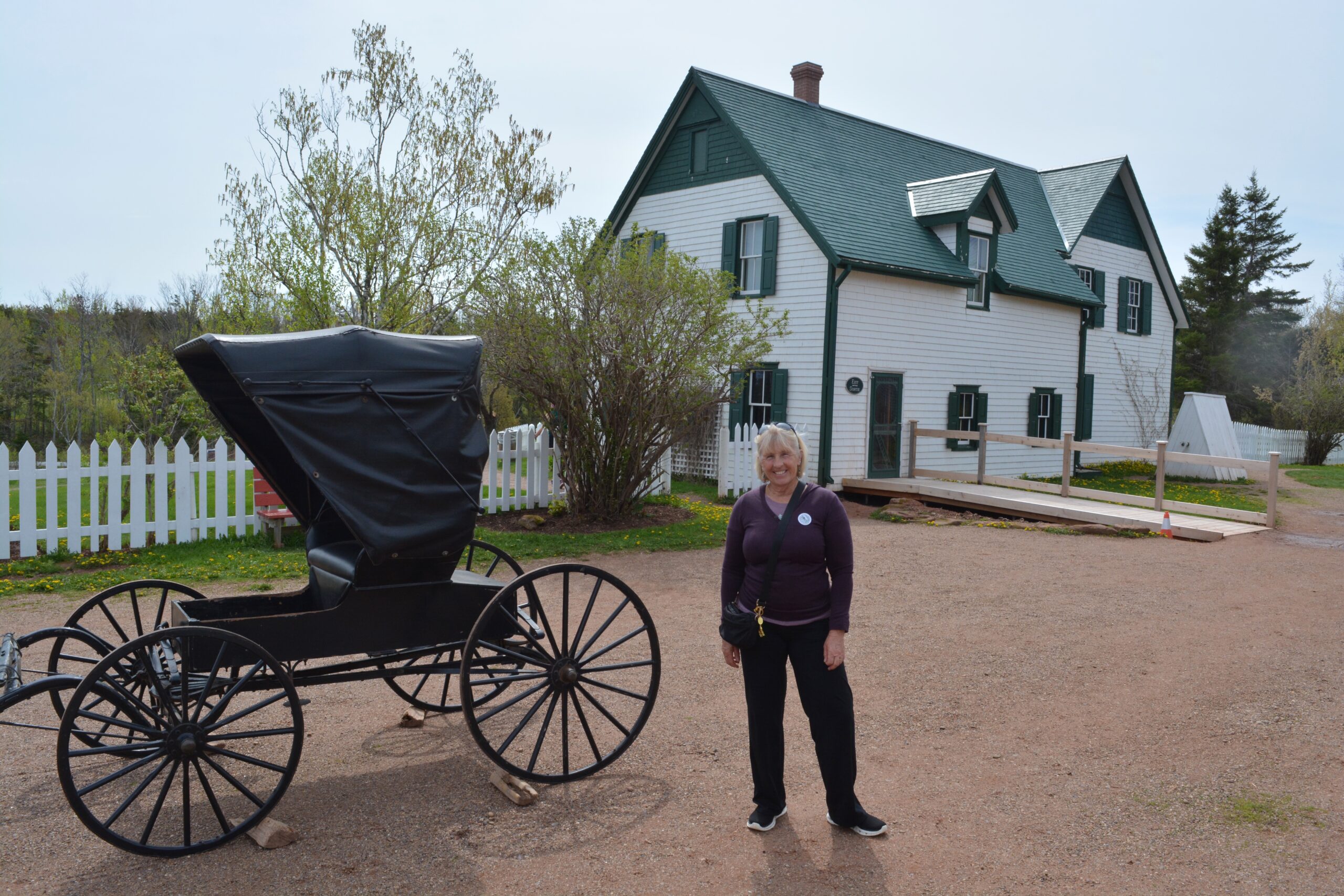
The World of Green Gables
Anyone who has ever read the L M Montgomery classic, Anne of Green Gables will have been whisked away to a wild landscape of rolling fields and woodland, fringed with rugged red sandstone cliffs. To be honest, we had never really thought about the novel’s setting until we spent some time in Prince Edward Island in Canada, and, on a whim, decided to visit the Green Gables Heritage Place which has been turned nto a museum celebrating the book and its author – and we were so glad we did.
It’s probably Prince Edward Island’s most visited tourist attraction, so it’s a bit of a cheat to call it an undiscovered place. But to be fair, we’d not heard about it until we were actually in Charlottetown, so it was undiscovered by us!
Who was L M Montgomery?
Lucy Maud Montgomery was by all accounts a remarkable woman. I have to admit, I had never really appreciated how remarkable she was – she was, to me, just the author of a book I’d never read (to my shame) and a TV series I didn’t enjoy. She published 20 novels and more than a thousand short stories and poems over the course of her career. Anne of Green Gables was an immediate success; the title character, orphan Anne Shirley, made Montgomery famous in her lifetime and gave her an international following.
She was one of the first authors to fight aggressively for her rights over her own creations. When her publisher, L.C. Page & Company, kept selling merchandise and film rights to Anne of Green Gables without her consent or fair compensation, she took them to court – and won, after nearly a decade of litigation. This was remarkably rare for any author, let alone a woman, in the early 20th century.
Inside the Museum
When you first enter the museum, there’s an exhibition about her life, In pictures and words, her life is laid out starting with her birth in the town of New London in Prince Edward Island in 1874, through her lonely upbringing with her grandparents following the death of her mother. She lived with her father in Saskatchewan for a while in her early teens and during that time her first work, a poem titled “On Cape LeForce” was published in the Charlottetown paper The Daily Patriot. She was as excited about this as she was about her return to Prince Edward Island in 1891.
She trained as a teacher – not a job she particularly enjoyed but it gave her time to write. And write she did, publishing more than 100 stories between 1897 and 1907. In 1908, Montgomery published her first book, Anne of Green Gables. An immediate success, it established Montgomery’s career, and she wrote and published material, including numerous sequels to Anne, for the rest of her life.

Publicly, Montgomery was cheerful, pious, and devoted – the model minister’s wife (she married Presbyterian minister Ewan Macdonald in 1911). Privately, her journals (published posthumously) reveal a much darker interior life: chronic depression, a marriage strained by her husband’s own severe mental illness, and deep unhappiness that she hid from the public for decades. Anne became a massive bestseller worldwide, yet Montgomery felt trapped by Anne’s success — she wrote several sequels somewhat reluctantly, wanting to be recognized for other work instead.

The landscape of Anne is essentially a love letter to the village of Cavendish, Prince Edward Island, and Montgomery rarely strayed from Maritime settings in her work. In the books, Prince Edward Island comes across as a charming part of Canada where people retain old-fashioned values and everything moves at a much slower pace. To be honest, it felt like that to us as visitors in the 21st century.
Visiting Green Gables
Once you’re through the exhibition, you walk out to the farmhouse itself which, not surprisingly, actually has green gables. Montgomery herself never lived there, but visited often and used it as the model for the fictional Green Gables. The farmhouse actually belonged to Montgomery’s cousins; the house and farm provided much of the inspiration for the book and has been furnished room by room to match Lucy Maud Montgomery’s descriptions in the novel, right down to items tied to specific scenes in the books.

The farmhouse layout, farmyard, and surrounding landscape became the literal blueprint for the fictional Cuthbert farm in the novel. The formal Victorian sitting room has a horsehair-covered settee and a pump organ, since families in the late 1800s usually kept their pump organ in the parlour, and Montgomery herself played the organ at the Cavendish Presbyterian Church where she met her future husband. There’s a nice bit of irony built into this room: Anne wanted to have tea with her friend Diana in the parlour, but Marilla insisted “the sitting room will do” for the girls that afternoon.
Anne’s bedroom is upstairs, decorated to match the book’s descriptions, complete with a brown dress with puffed sleeves for Anne on display, evoking the famous puffed-sleeves scene. Watch out for things like a hanging print of children saying bedtime prayers, a common decoration in 1800s homes, which ties directly to the scene where Anne says her first, rather unconventional prayer at Green Gables on her first night, ending it “yours respectfully” instead of “Amen”. Downstairs again is the kitchen, the heart of the house, set up as a working farm kitchen as it would have been in the late 1800s, with period cookware and furnishings. If you’ve watched the Netflix adaptation of the series Anne with an ‘e’, as we have recently, you may be surprised as quite how small the rooms are in real life.

A walk down ‘lover’s lane’
Also on the site are two of the most iconic literary walks in Canada, the Haunted Wood and Lover’s Lane, both named directly after locations in the book. We set off down Lover’s Lane, with quite a group of people but most of them turned back after a couple of hundred metres. But it’s worth carrying on further to really get a sense of the peace and tranquillity that Montgomery treasured so much. Follow the path of packed gravel alongside a winding brook in the woods but watch out for exposed roots after rain.
Signs along the trail point out the specific spots and details that inspired her descriptions, and some of the wildlife you might see. To be honest, the charm is less about the scenery itself and more about recognizing that Montgomery turned what were really just rural cowpaths into two of literature’s most famous woodland walks.

During the summer, the centre can get very busy. We visited quite early in the morning, and were able to enjoy the site in relative peace and quiet, but by the time we left, it was getting quite a lot busier.
A separate site about 15 minutes away, at the actual home of Montgomery’s aunt and uncle. This property has been owned by the Campbell family since 1776 and is still operated by descendants of her Aunt Annie and Uncle John Campbell. This one has a much more personal, biographical connection to Montgomery herself — it’s filled with original furnishings and artifacts, including Anne’s Enchanted Bookcase, the author’s hand-sewn Crazy Patchwork Quilt, and her self-developed photographs. Notably, this is the parlour where Montgomery chose to be married on July 5, 1911, and couples still travel here to marry in the same room. The grounds include Anne’s famous “Lake of Shining Waters” and you have the option of taking a carriage ride.
Getting there
Getting to Green Gables Heritage Place in Cavendish is pretty straightforward — PEI is small, so nothing is too far.
- By car: It’s about a 30–40 minute drive north from Charlottetown to Cavendish. The site’s address is 8619 Cavendish Rd, Cavendish, PE, and it’s well signposted once you’re in the Cavendish area. There’s a parking area on site.
- Public transport: Good news – there is now a public transit option, but – bad news – it’s seasonal. The T3 ‘Northshore and Cavendish’ route service runs from June 16 to September 1, offering five daily trips between Charlottetown and Cavendish. At the time of writing it cost just $2 for a one way trip. It runs Monday to Friday and weekends on separate schedules, so it’s worth checking T3 Transit’s site for exact stop times before you go.
- Taxi or rideshare (PEI has a rideshare app called Kari/URide)

Related Post
The Titanic Legacy
Canada’s East coast has an indelible connection with the Titanic tragedy. When the RMS Titanic…